
best budget home theater speakers small rooms is really a question about fit, not hype: what will sound clear at low-to-moderate volume, won’t overwhelm your space with boomy bass, and still makes dialogue easy to understand.
If you’ve ever tried a “big” speaker setup in a bedroom, office, or apartment living room, you know the pain, explosions get louder but voices don’t get clearer, bass feels like a blob, and you end up riding the volume all night. Small rooms amplify certain frequencies and punish bad placement, so budget gear can sound worse than it should if you pick the wrong form factor.
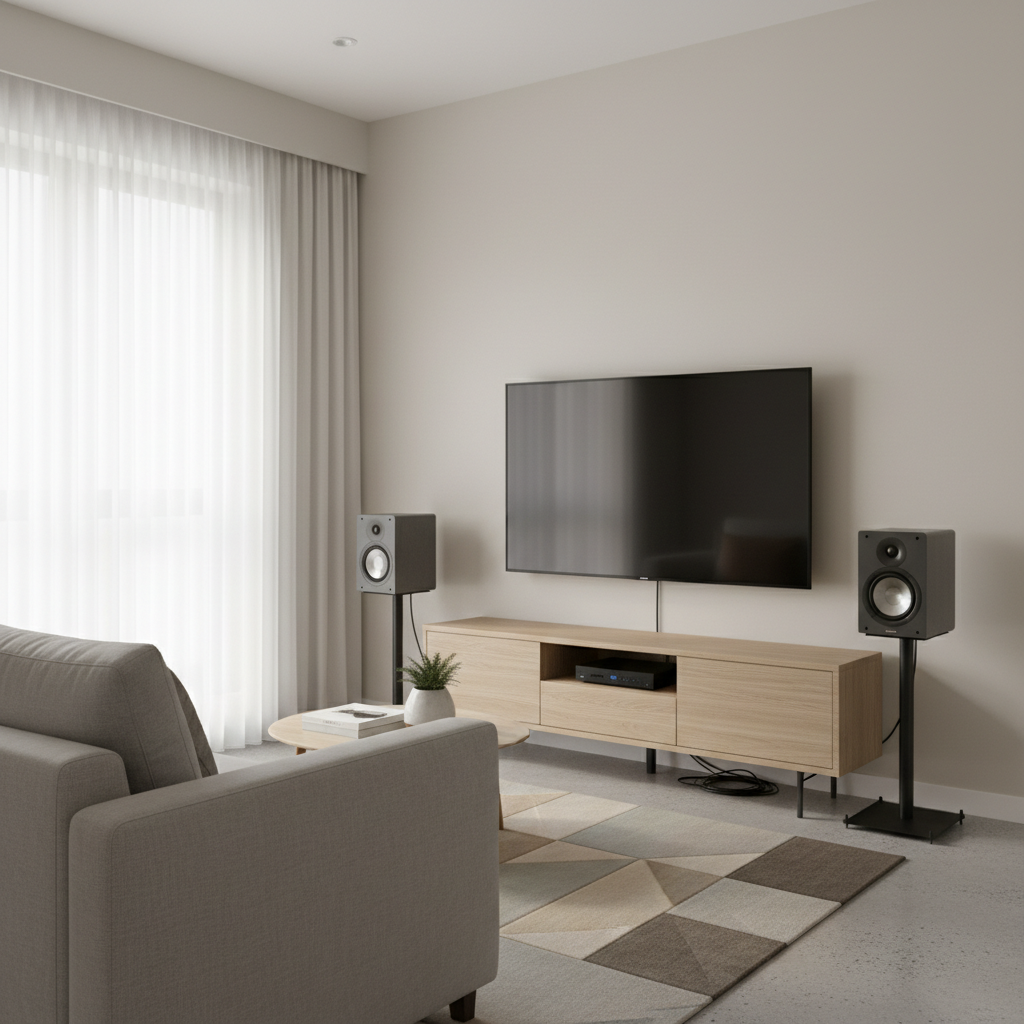
This guide helps you choose a realistic speaker layout for a small room, compare popular budget paths (soundbar vs. 2.0/2.1 vs. 5.1), and avoid the common mistakes that waste money. You’ll also get a quick checklist, a comparison table, and a few placement moves that usually improve sound more than upgrading hardware.
What “budget speakers for a small room” actually means
In small spaces, the goal is controlled sound, not maximum output. The best budget home theater speakers for small rooms are usually compact, easy to place, and voiced for clarity rather than chest-thump.
- Room size matters more than wattage: a 10x12 ft room can hit “loud enough” with modest speakers, but it can also get muddy fast.
- Near-wall placement is common: many people must put speakers close to a wall or inside a media console area, which boosts bass and can blur mids.
- Listening distance is short: you’re often 6–10 feet from the TV, so smooth off-axis sound (how it sounds slightly to the side) becomes important.
Also, “budget” is personal. Some shoppers mean under $200 total, others mean under $600 with a receiver. I’ll keep recommendations framework-based so you can map them to your price range.
Common problems in small rooms (and why they happen)
Most disappointing setups share the same few issues, and they’re not always fixed by spending more.
- Boomy or one-note bass: small rooms create strong low-frequency peaks, especially when speakers or a sub sit in a corner.
- Dialogue gets lost: TV reflections (hard floors, bare walls) smear the midrange, and weak center-channel placement makes it worse.
- “Loud but not detailed” sound: cheap speakers pushed too hard compress, and poor positioning exaggerates harshness.
- Neighbor complaints: bass travels, and many apartments share walls or floors that transmit low-end easily.
According to Dolby Laboratories, proper speaker placement and calibration are key parts of getting accurate surround and dialogue performance in home theaters. In small rooms, that advice becomes even more practical: placement can be the difference between “thin and sharp” and “surprisingly cinematic.”
Quick self-check: which setup fits your room?
Before you buy anything, answer these quickly. Your best option usually becomes obvious.
- Can you place speakers on stands (not inside a cabinet)? If yes, bookshelf speakers become a strong value play.
- Do you need simplicity over upgradeability? If yes, a better soundbar may beat a complicated budget surround kit.
- Is late-night viewing a priority? If yes, look for strong dialogue modes, or plan a 3.0 setup (L/C/R) with good center clarity.
- Do you have downstairs neighbors? If yes, you may want a smaller sub or even skip it at first, then add later if needed.
- Do you already own an AV receiver? If no, factor that cost in, it changes what “budget” looks like.
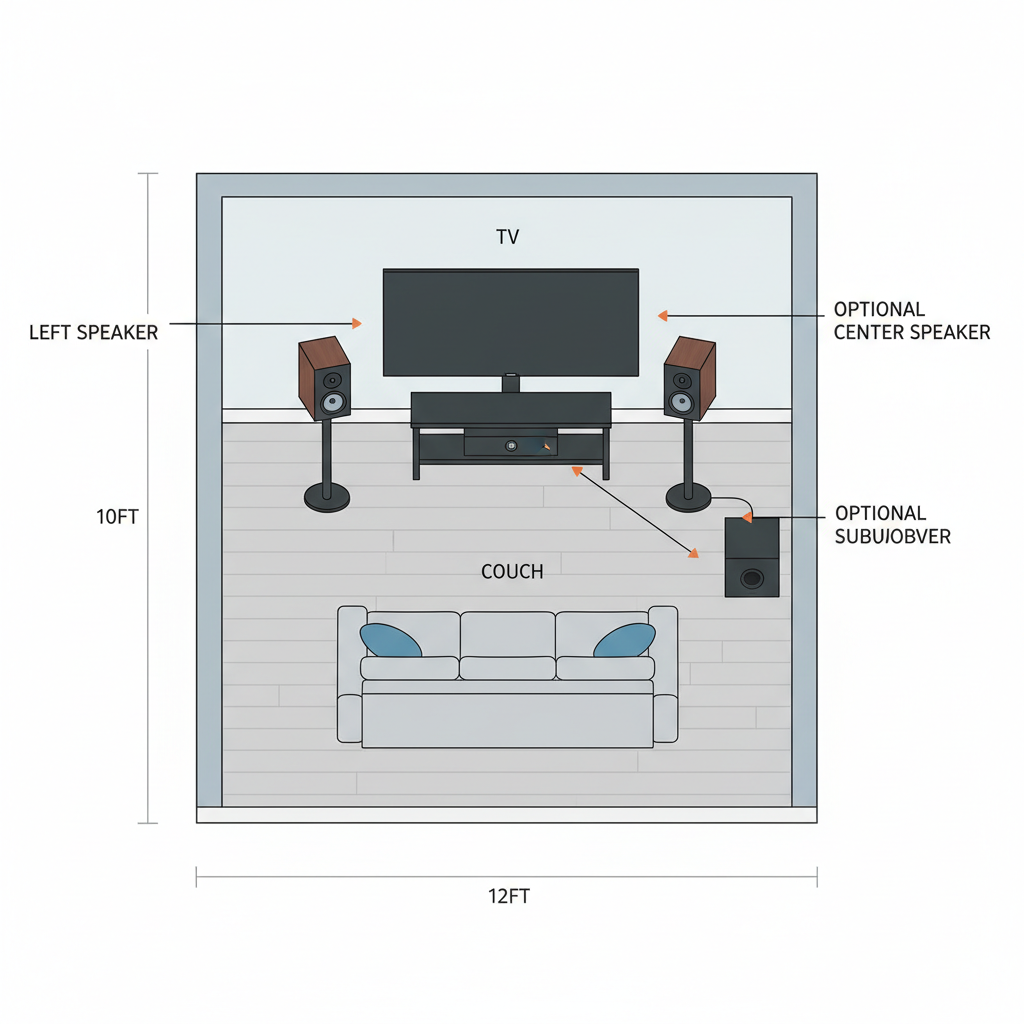
If you’re stuck between two options, default to the one you can place correctly. A “worse” speaker in a good position often beats a “better” speaker crammed into a console.
Best budget paths for small rooms (with a realistic comparison)
Here are the common routes people take, plus what they tend to do well in compact spaces.
| Setup path | Why it works in small rooms | Trade-offs | Who it’s for |
|---|---|---|---|
| Soundbar (2.0/2.1/5.1 virtual) | Simple, tidy, usually good dialogue modes | Soundstage can feel narrow, upgrades limited | Max simplicity, minimal gear |
| 2.0 bookshelf + receiver/amp | Great clarity and imaging at short distance | No deep bass without a sub | Music + movies, small seating area |
| 2.1 (bookshelf + sub) | Fuller impact while keeping speakers compact | Sub placement and volume can annoy neighbors | Action movies, games, still compact |
| 3.0 (L/C/R) | Best budget jump for dialogue clarity | Needs space for a center, costs more | Dialogue-first viewers, TV heavy |
| 5.1 compact satellite kit | True surround in tight rooms if positioned well | Satellites can sound thin; more wiring | Movie nights, you can place rears correctly |
For many people searching best budget home theater speakers small rooms, the “sweet spot” is either 2.0/2.1 with compact bookshelves or a 3.0 that prioritizes speech. Full 5.1 can be great, but only if the room allows proper rear placement and you’re okay with cables.
What to look for when choosing speakers on a budget
Specs can help, but don’t let them bully you. In small rooms, a few practical traits usually matter more.
Speaker size and cabinet style
- Bookshelf speakers: often the best value per dollar, especially when you can use stands and keep them off the TV console.
- Compact satellites: easier to hide, but can struggle with midrange body unless crossed over carefully with a sub.
Front-ported vs. rear-ported
Rear ports can get boomy when pushed close to a wall. Front-ported designs can be more forgiving in small-room placement, though it still depends on the model and the room.
Center channel (if you can swing it)
If dialogue is your number-one complaint, a decent center channel and correct placement is often a bigger win than chasing a bigger sub. Put it as close to ear height as possible, angled toward the listener.
Subwoofer control, not just output
In apartments, a smaller sub with good controls (phase, crossover, volume) can be easier to blend. You’re aiming for bass you notice when it’s gone, not bass that shakes the hallway.
Practical setup steps that improve sound fast
You can do these in an hour, and they’re the kind of unglamorous tweaks that make budget systems feel “expensive.”
- Start with speaker placement, then touch EQ: pull L/R speakers a little away from the back wall if you can, even 6–12 inches may help.
- Get tweeters near ear level: if your speakers sit low, use stands or angled isolation pads.
- Use a simple “triangle”: try to keep the distance between the L/R speakers similar to the distance from each speaker to your main seat.
- Subwoofer crawl (for 2.1): place the sub at your seat, play bass-heavy content at low volume, walk the perimeter to find the smoothest spot, then put the sub there. It’s awkward, but it works in many rooms.
- Calibrate if you have a receiver: run the built-in room correction, then sanity-check levels by ear. According to Audyssey, calibration and correct mic placement are important for room correction to behave as intended.
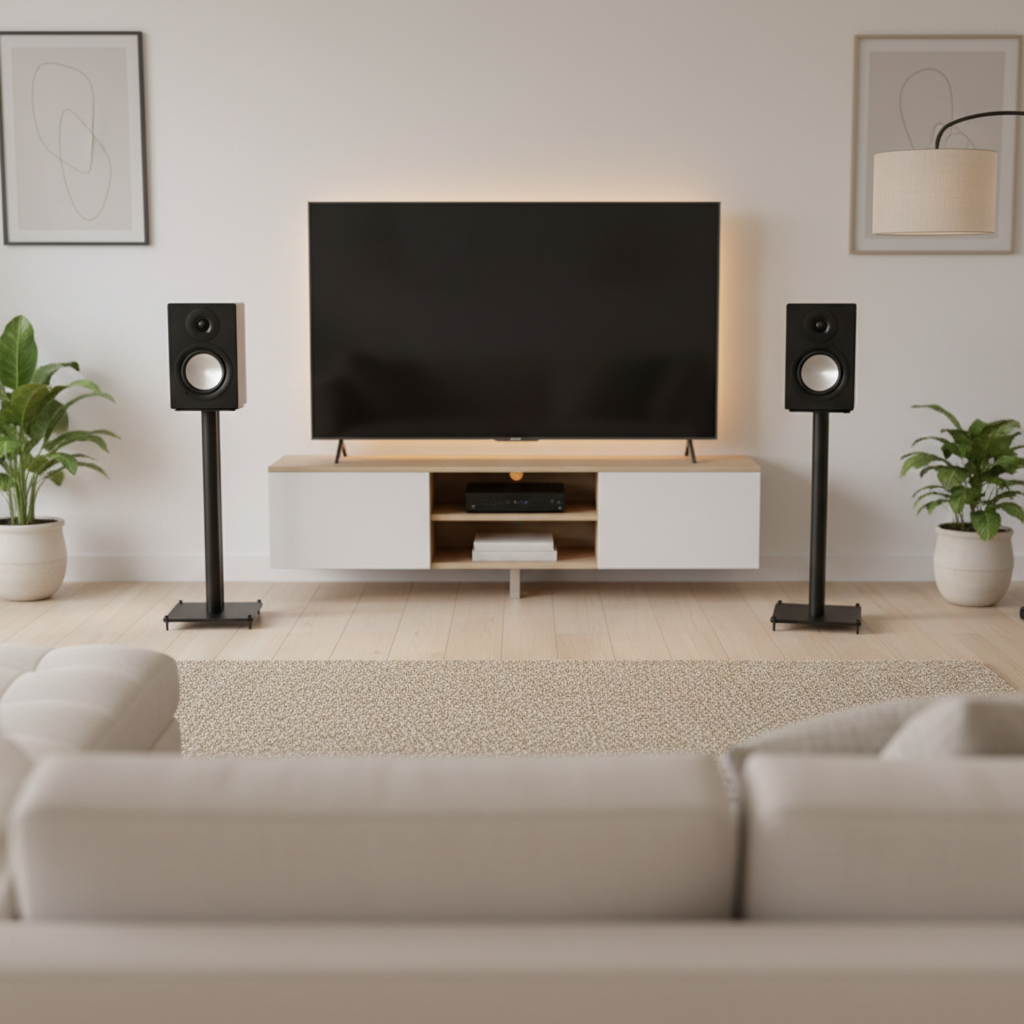
If you can only do one thing, fix the height and spacing of your front speakers. That alone often reduces “shouty” treble and improves center imaging, which makes dialogue easier without cranking volume.
Mistakes that waste money in small rooms
- Buying a huge sub first: in compact rooms, too much low-end can mask dialogue and upset neighbors. You can add bass later.
- Placing speakers inside a cabinet: it creates reflections and resonances. If you must, leave space around the speaker and consider front-ported options.
- Ignoring the center channel angle: a center firing at your knees makes voices feel detached from the screen.
- Chasing “surround” when your couch is against the back wall: rear speakers end up inches from your ears, and the effect can feel distracting instead of immersive.
- Over-EQing treble: harsh sound is often placement and reflections, not a “need more sparkle” problem.
When people say budget systems sound “cheap,” it’s often these setup mismatches, not the speaker drivers themselves.
When it’s worth getting expert help
If your room has weird constraints, like open-concept layouts, lots of glass, or you can’t move the couch, a quick consult with an installer or an audio-focused retailer can save you multiple returns. The same goes if you’re running in-wall wiring, mounting speakers, or adding power management, it’s safer to have a pro confirm the plan.
And if neighbor noise is a real concern, you might want to ask your building management about quiet hours and construction details, then tune your bass strategy around that reality rather than fighting it.
Conclusion: a small room can sound great on a budget
The best budget home theater speakers for small rooms are the ones you can place properly and listen to comfortably, clear dialogue, controlled bass, and a soundstage that doesn’t feel trapped inside the TV. If you’re unsure where to start, a good 2.0 bookshelf setup (or 3.0 if voices are your priority) is often the most satisfying “first buy.”
Action steps: measure your space, decide whether you can use stands, then pick the simplest setup you’ll actually place correctly. After that, spend 30 minutes on positioning and calibration before you spend another dollar on upgrades.
FAQ
What’s the best setup type for a very small bedroom TV?
Often a quality soundbar or a compact 2.0 setup makes more sense than squeezing in 5.1. If you sit close to the screen, clean front sound and good dialogue matter more than rear effects.
Are bookshelf speakers better than a soundbar for small rooms?
They can be, especially for stereo imaging and music, but only if you can place them well. If your TV stand forces awkward placement, a soundbar may deliver more consistent results with less effort.
Do I need a subwoofer in an apartment?
Not always. Many people start with 2.0 or 3.0 and add a sub later if they can keep it low and controlled. If you add one, keep volume modest and experiment with placement to avoid boomy peaks.
How do I improve dialogue without buying new speakers?
Try moving speakers off the back wall, angling the center toward ear level, and reducing reflections with a rug or curtains. If you use a receiver, re-run calibration and confirm the center channel level isn’t too low.
Is 5.1 worth it in a small room?
It can be, but the room has to cooperate. If your couch is against the back wall, surround placement becomes tricky and may feel too localized. In that case, strong front sound (2.1 or 3.1) may be more satisfying.
What receiver features matter most for budget home theater in small rooms?
Reliable room correction, easy crossover settings for a sub, and enough HDMI inputs for your devices. Fancy power ratings matter less than setup tools and usability in compact spaces.
How can I keep bass from bothering neighbors?
Lower the sub level, avoid corner placement, and consider an isolation pad. Some receivers also offer “night mode” or dynamic range compression, which may help reduce sudden loud moments.
If you’re trying to buy once and avoid the return-carousel, start by sketching your room and listing what you can realistically place, then choose the simplest speaker path that matches that layout. If you want, share your room dimensions and where the TV/couch sit, and it’s usually possible to narrow your options quickly.